

Brush hogging cuts grass, weeds and light brush down to a mowable height, while forestry mulching grinds thicker brush and small trees into chips where they stand. The right one depends on how far the land has gone and what you want it to be when the work is done.
What brush hogging does
A brush hog is a heavy-duty rotary cutter. It knocks down tall grass, weeds, goldenrod, briars and young woody growth that a lawn mower or finish mower would choke on. It is the tool for a pasture that skipped a season or two, a field edge creeping inward, or a lot that needs to be opened up so you can see what you have.
It works fast across open ground and leaves the cut material lying on the surface to break down. What it does not do well is handle established woody stems. Once saplings are thicker than the cutter is built for, or the ground is full of trunks and old stubs, a brush hog starts to bounce and tear instead of cut. That is the point where the job changes.
What forestry mulching does
A forestry mulcher is a heavy cutting head on a tracked machine. It chews standing brush and small trees from the top down and leaves the material as a layer of mulch on the ground. There is no pile to burn, no logs to haul and no ruts from dragging debris out.
Because the stumps stay in the ground, the soil stays firm and there are no holes to fill. That makes mulching a good fit for reclaiming a field that has turned into thicket, opening up woodlot undergrowth, cutting trails and access lanes, or clearing fence rows. Larger trees beyond what the head handles come out with the excavator instead, and George will say which is which at the estimate.
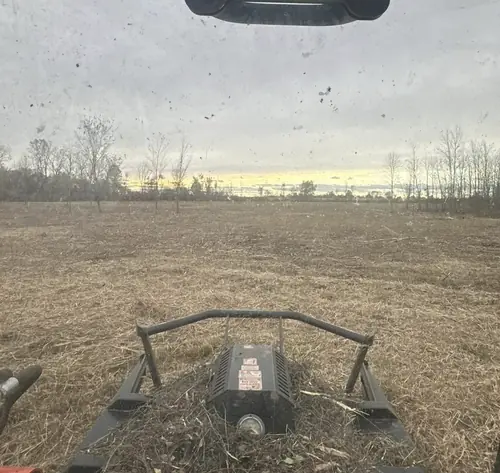
Fields gone to brush
Open land in Michigan does not stay open on its own. A field that stops being mowed or farmed fills with grasses and wildflowers first, then shrubs, then young trees. How far along it is decides the tool.
If it is mostly tall grass and soft growth with a few small woody stems, brush hogging brings it back. If shrubs and saplings have closed in and you cannot walk through it easily, mulching is usually the faster and cleaner route. Many properties get both: the mulcher goes through once to take out the woody growth, then the field is kept open with regular brush hogging after that. Catching a field earlier keeps the work lighter and the bill smaller.
Autumn olive, buckthorn and other invasive shrubs
Two shrubs come up on a lot of overgrown ground here. Michigan's invasive species program lists autumn olive as a restricted species. It was planted for wildlife, spreads quickly in abandoned fields, and birds carry its seed. The state notes that cut stumps and roots resprout, which is why a single cut rarely ends it.
Glossy buckthorn is also profiled by the state as an invasive shrub, found along fence rows, roadsides, pastures and wet ground. Mulching knocks these shrubs back and opens the land, but plan on follow-up. Regular brush hogging keeps the regrowth down, and MSU Extension and the Michigan Invasive Species program have guidance on longer-term control if you want them gone for good.
Small trees, fence rows and woodlots
Fence rows and treelines are where the two methods overlap most. Brush hogging can keep a fence row trimmed back once it is under control. Getting it under control, when the row has grown into a band of saplings and vines, is mulching work.
In a woodlot you want to keep, mulching can clear the undergrowth and leave the trees you choose standing, so you can walk it, hunt it or get a machine through. Mark the trees that stay before the work starts. If the plan is a building site rather than a cleaner woods, full land clearing and site preparation with stump removal is likely the better fit, because a house or barn pad needs bare, solid ground.
Elite does both, so the estimate fits the land
Because Elite runs both a brush hog and a mulching head, the recommendation does not have to bend toward one machine. When George walks the property, he looks at how thick the growth is, how big the woody stems are, where the ground is soft, and what you want the land to be next.
Some jobs are pure brush hogging. Some are pure mulching. Many are a mulching pass now and periodic cutting after. You can read more on the brush hogging and forestry mulching page, and if the land ends up needing a smoother surface afterward, grading and land leveling can follow. Free estimates at (989) 702-2426.
The Short Version
- Brush hogging cuts grass, weeds and light brush on open ground.
- Forestry mulching grinds thicker brush and small trees into mulch where they stand.
- How far a field has gone back decides which tool fits.
- Autumn olive is restricted in Michigan and resprouts after cutting, so plan follow-up.
- Many properties get one mulching pass, then regular brush hogging.
Quick Answers
Can a brush hog take down small trees?
It handles young, thin woody growth. Once saplings are thicker than the cutter is built for, the machine bounces and tears instead of cutting, and a forestry mulcher is the better tool.
Does forestry mulching kill autumn olive?
It cuts it down, but Michigan's invasive species program notes that autumn olive stumps and roots resprout. Plan on follow-up cutting, and look to MSU Extension or the state invasive species program for longer-term control guidance.
What happens to the mulch after a forestry mulching job?
It stays on the ground as a layer of chips and breaks down over time. It helps hold the soil and keeps you from dealing with a burn pile or hauling.
How often should an overgrown field be brush hogged once it is cleared?
Often enough that woody growth never gets ahead of the cutter again. For many fields that is once or twice a year. George can suggest a schedule after seeing what is growing back.
See the brush hogging & mulching service or call (989) 702-2426.