

Forestry mulching is priced mostly by machine time, so the cost and the hours per acre both come down to how thick and how big the growth is, how the ground lies, and how easily the machine can work it. Two acres that look alike from the road can take very different time, which is why an honest number comes from walking the land.
Why machine time is the real price
A mulching job does not involve trucks, dump fees or loads of material. The work is one machine and one operator grinding standing growth into chips. That means the price follows how long the machine has to run, and anything that slows it down raises the cost.
This is also why a single per-acre figure from the internet tells you so little. An acre of light brush and briars can go quickly. An acre of dense saplings packed shoulder to shoulder can take many times longer, even though it is the same size on the map. The question to ask is not how big the area is, but how long it will take to grind what is standing on it. If you want the bigger picture on clearing prices, our guide on land clearing cost covers the clearing side.
Stem size and how thick the growth is
The two biggest factors are how big the stems are and how many of them there are. Grass, weeds and light brush mulch fast. Thick saplings take more passes. Small trees take longer again, because each one has to be ground down from the top, and trees bigger than the mulching head can handle have to be cut and moved with the excavator instead.
Density multiplies all of it. Scattered brush with open ground between it lets the machine move steadily. A thicket where every foot is solid stems slows it to a crawl. Hardwood is slower to grind than soft, brushy growth. When George walks a job, this is most of what he is looking at: what is growing, how big it is and how tightly it is packed.
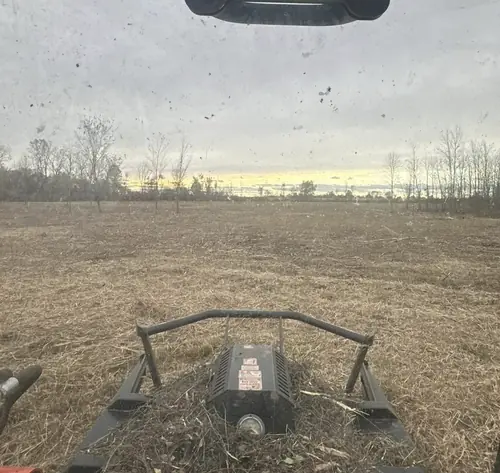
How long it takes to mulch an acre
This is one of the most common questions, and the honest answer is that it depends on the same things as the price. Light brush on flat, dry ground goes much faster than dense saplings on a wet or uneven site. A rough figure from someone who has not seen the land is a guess.
What you can get is a time estimate for your own property. After walking it, George can tell you roughly how long the job will run, whether it fits in one visit or needs more, and whether some of the growth is better handled by clearing than mulching. That is far more useful for planning than an average, especially if you are timing the work around a hunting season, a planting date or a builder's schedule.
Ground, slope and wet spots
The machine works fastest on firm, flat ground. Slopes, ditch banks, ravines and rough ground slow it down, and some of it may need extra care to work safely. Old fence wire, rock piles, buried junk and stumps from earlier cutting can hide in the brush, and finding them the hard way costs time and repairs.
Wet ground is the big one in this part of Michigan, where much of the land is heavy clay that drains slowly. A soggy stretch means the machine works slower and leaves ruts that may need repair. Choosing a dry stretch, or frozen ground where that suits the site, often brings the cost down. If any area stays wet most of the year, check with EGLE about wetlands before it is worked.
Access, finish and what is staying
How the machine gets to the work matters. A field right off the road with a wide gate is simple. A back acre reached through a woodlot, across a lawn or down a narrow lane takes more time before mulching even starts.
The finish you want changes the hours too. Mulching down to a mowable surface is more passes than knocking brush back to open the land up. Working around trees, a pond edge or a treeline you want kept takes more care than mulching a field edge to edge. Marking what stays before the estimate, with flagging tape on trees or a walk around the boundary, keeps the price clear and keeps the wrong thing from being cut.
Keeping the cost down
The mulching job that costs least is the one done before the brush gets big. A field that has gone a few years is far quicker to bring back than one left for a decade, and once it is open, regular mowing keeps it there. Our guide to brush hogging vs forestry mulching explains when a brush hog can take over.
Know your property lines, decide what each area is for, and put the big trees on the list separately so the estimate shows mulching and any clearing as different items. Elite gives free estimates, and George walks every job before pricing it. Call (989) 702-2426 to set up a walk-through.
The Short Version
- Mulching is priced by machine time, so anything that slows the machine raises the cost.
- Stem size and how thick the growth is matter more than the size of the area.
- Time per acre depends on the same things, so get a time estimate for your own land.
- Wet clay, slopes and hidden fence wire or debris add hours.
- Mulching before brush gets big, then mowing to keep it open, costs least over time.
Quick Answers
How long does it take to forestry mulch one acre?
It depends on how big and how thick the growth is, how flat and dry the ground is, and how easily the machine gets to it. Light brush goes fast; dense saplings take much longer. George can give you a time estimate after walking your land.
Why do forestry mulching quotes ask about tree size?
Because tree size is one of the biggest drivers of machine time. Brush and saplings grind quickly. Trees bigger than the mulching head can handle have to be cut and handled with the excavator, which is priced as a separate part of the job.
Does mulching in winter cost less?
Sometimes. Frozen ground can let a machine work wet areas without rutting, which saves repair work. It depends on the site and the weather that year. Ask about timing during the estimate.
Can I get a forestry mulching price over the phone?
Not an honest one. The price follows what is growing and how the ground lies, which nobody can see over the phone. Call (989) 702-2426 and George will walk the property and give you a free estimate.
See the brush hogging & mulching service or call (989) 702-2426.