

A gravel driveway is built from the bottom up: the road agency signs off on the approach, the soft topsoil comes out, a compacted stone base goes in, and the top stone is crowned so water runs off. The company that does that work is an excavating contractor, and around Capac and the St. Clair, Lapeer and Macomb County towns Elite Excavating builds drives start to finish.
Start at the road: the approach and the permit
Before anyone digs, find out who owns the road the drive will meet. On a county road that is the county road commission. The St. Clair County Road Commission, for example, states that a permit is required to construct, operate, use or maintain any work within the public right-of-way, and the strip between your property line and the pavement usually sits in that right-of-way. On a state highway such as M-19 or M-53 the road owner is MDOT.
The road agency decides whether you need a permit for the approach, where it can go and what it wants under it, including the culvert. Our guide to driveway culvert permits explains who to call in more detail. Get that answer first, because it fixes where the drive starts and what the approach has to look like.
Call MISS DIG 811 before the first cut
Michigan's utility notification system is MISS DIG 811. You reach it by calling 811 or by filing a request online, and MISS DIG says that if you hire a contractor, you should make sure the contractor makes that contact. Work cannot start before the start time on the locate request, even if every line has already been painted and flagged.
MISS DIG marks public utility lines. Private lines, such as a buried power feed to a pole barn, a line out to a yard light or a water line from a well, are generally yours to locate, so tell your contractor where you think they run. The MISS DIG guide covers what gets marked and what does not. A driveway cut is shallow compared with most digging, but it is still digging, and the call still comes first.
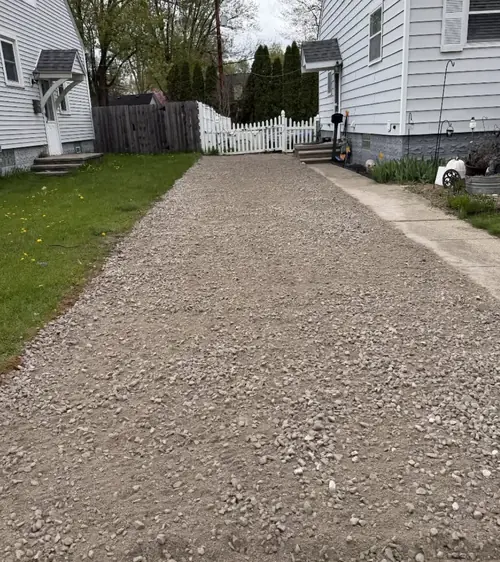
Lay out the route and strip the topsoil
Walk the route before deciding on it. A drive that follows the high ground drains on its own; one that dips through a low spot fights water every spring. Think about what will use it: a car, a pickup with a trailer, a delivery truck, a camper or farm equipment. That sets the width, the turning room at the house and whether you want a turnaround or a parking pad.
Once the route is marked, the topsoil comes off. Topsoil is full of roots and organic matter and stays soft, so stone placed on it sinks and ruts. It gets stripped back to firmer ground and stockpiled, because it is useful later for dressing the edges of the drive and the ditch banks so grass can grow back. Skipping this step is the most common reason a new gravel drive fails early.
Build the base in compacted layers
The base is the part of a gravel driveway that carries the weight, and it is where most of the work goes. Much of the Thumb sits on clay, which holds water and turns soft in spring. Soft pockets get dug out and replaced, and on ground that stays wet a geotextile fabric is sometimes laid down first to keep the stone from pushing into the clay.
Base stone then goes in a layer at a time, and each layer is compacted before the next one. How thick the base needs to be depends on the soil and the traffic, so it is set on site, not from a chart. A drive built this way holds its shape through the thaw. Stone simply dumped on soft ground, with nothing done underneath, will rut by spring.
Top stone, crown and ditches
The surface layer is a finer crushed stone that packs into a hard driving surface. Some owners choose asphalt millings instead for a firmer, low-dust top, and our guide to asphalt millings driveways covers the trade-offs. Either way the surface is shaped with a crown, higher in the middle than at the edges, so rain runs off both sides instead of sitting in the wheel tracks.
Water that runs off has to go somewhere. Along a field or on a slope the edges may need shallow ditches or swales, and a drive that crosses a low spot may need a cross culvert so water passes under it rather than over it. The last step is dressing the shoulders with the stockpiled topsoil so the edges hold and grass can come back.
Timing around spring thaw and frost laws
Wet clay is the enemy of a new drive, so timing matters. In early spring the frost is coming out of the ground and soil that looks firm can be soft a little way down. Building on it, or running loaded trucks over it, can do more harm than good.
Michigan road agencies also post seasonal weight restrictions, often called frost laws, on many roads while the ground thaws. Those can limit how much a loaded stone truck can carry on the roads to your property. The dates and the roads covered change, so check the current notice from your county road commission or MDOT. Our guide to Michigan frost laws explains how they work. Late spring through fall is usually the easier window for driveway work, and a contractor should tell you plainly if your ground needs to dry out first.
What kind of company installs gravel driveways
A gravel driveway is excavation and grading work, so the company you want is an excavating contractor with the equipment to strip, haul, place and compact, not just a supplier who drops a load of stone at the road. The same contractor should handle the culvert and the approach to the road agency's requirements, the base, the crown and the cleanup.
Elite Excavating builds new gravel drives, repairs and regrades old ones, and installs asphalt millings across St. Clair, Lapeer and Macomb counties. See the driveway installation and repair page for what that covers. George walks the route with you before giving a number, so the estimate reflects the ground you actually have. Call (989) 702-2426 to set up a free estimate.
The Short Version
- Ask the road owner first: the county road commission on county roads, MDOT on state highways.
- Contact MISS DIG 811 before digging, and point out private lines yourself.
- Strip the topsoil and build a compacted base in layers; that is what keeps a drive from rutting.
- Crown the surface and give the water somewhere to go.
- Avoid building on thawing, saturated ground, and check current frost law notices for deliveries.
Quick Answers
Can I build a gravel driveway myself in Michigan?
Some owners do a short drive themselves, but the hard parts are stripping the topsoil, building and compacting the base, and getting the approach right for the road agency. Without a compactor and a way to move material, most DIY drives end up as stone on soft ground. Whoever does it still has to contact MISS DIG 811 and check the road agency's permit rules first.
Do I need a permit to put a gravel driveway on a county road?
Ask the county road commission before building. The St. Clair County Road Commission states that a permit is required for any work within the public right-of-way, which is where a driveway approach usually sits. On a state highway, ask MDOT. Your township may also have rules about driveway location, so check with the township office too.
What should I have ready before a driveway estimate?
Know roughly where the drive will start and end, what will drive on it, and whether you want a turnaround or parking area. Any answer you already have from the road agency about the approach or culvert helps. Photos are useful, and George will walk the route with you either way.
See the driveways service or call (989) 702-2426.